

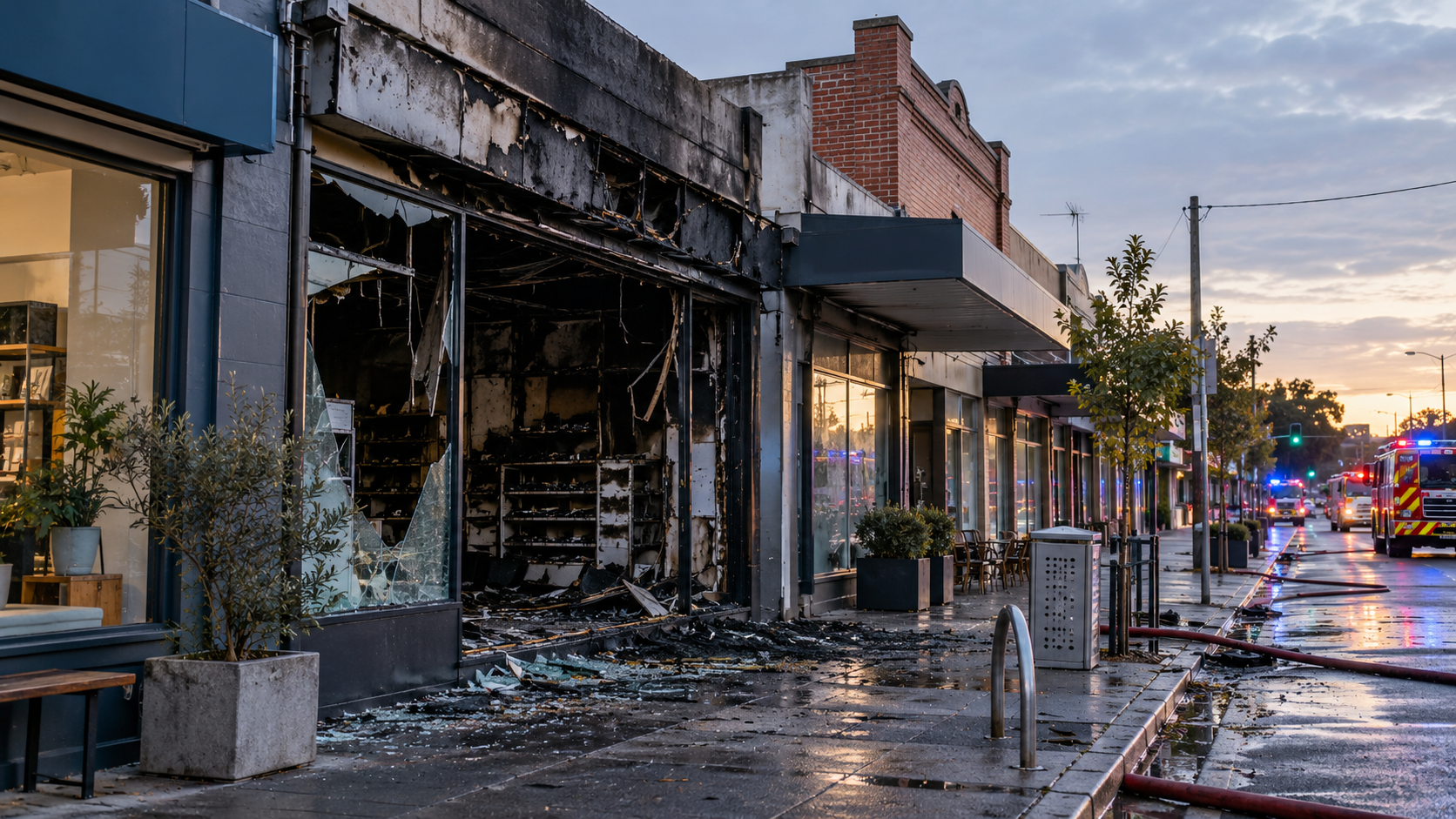
The fire is the part we see. A vehicle hits a shopfront. Accelerant is poured. A business burns, neighbouring traders are damaged and another young offender may be arrested.
But Victoria’s illicit tobacco war is not fundamentally an arson problem. It is a business model.
The market has a cheap product, persistent consumer demand, an enormous price advantage over the legal alternative and a distribution network that can replace seized stock, closed stores and arrested participants. Violence is used to protect market share, collect debts, enforce supply arrangements and frighten competitors.
If government treats each fire as an isolated crime scene, it will repeatedly arrest the people at the bottom while leaving the commercial system above them intact.
What is driving Victoria’s illicit tobacco war?
The short answer is profit created by a large gap between the price of legal and illegal tobacco. Organised crime can import or distribute cheap tobacco, sell it through apparently ordinary retail businesses and generate recurring cash income. Firebombings, extortion and intimidation are methods used to control that market—not the market itself.
The Australian Bureau of Statistics’ experimental estimates show how dramatically purchasing has shifted. Between 2017 and 2025, total nicotine consumption increased by almost 40 per cent while legal tobacco consumption fell to less than one-third of its 2017 level. The ABS estimated that illicit sources accounted for 80 per cent of nicotine consumed in 2025, although it cautions that its methodology is experimental and broader than some other estimates.
Most importantly for understanding the business model, the ABS found that legal tobacco prices had almost tripled since December 2016 while estimated illicit prices remained relatively stable. Consumers did not simply disappear from the market. Many changed suppliers.
That price gap is the opportunity organised crime is exploiting.
The criminal supply chain is bigger than the shopfront
The tobacconist is the visible end of a much longer supply chain:
- tobacco or finished cigarettes are sourced offshore or produced unlawfully;
- importers and facilitators move the product across the border;
- wholesalers store and distribute it across jurisdictions;
- cash, transport and communications networks support the trade;
- retailers sell to an established customer base; and
- violence, debt collection and intimidation protect the commercial structure.
Not every person at every level belongs to one hierarchical organisation. Criminal markets are often networks of suppliers, brokers, retailers, money movers and contracted offenders whose interests overlap. Participants can change while the market continues.
That is why the enterprise survives individual arrests. Remove one courier and another can be recruited. Close one retailer and customers can move to a nearby store, an online seller or a delivery service. Seize one shipment and another supplier may fill the shortage.
The Australian Border Force reported seizing more than 2.2 billion cigarette sticks and 586 tonnes of loose-leaf tobacco at the border during 2025–26, representing more than $4.7 billion in estimated duty evasion. Those results are significant. They also reveal the scale and adaptability of the supply confronting authorities.
Record seizures are evidence of enforcement activity. They are not, by themselves, proof that the market is shrinking.
Violence is a commercial tool
The language of a “tobacco war” can make the violence sound chaotic. Much of it is better understood as commercial enforcement conducted outside the law.
A fire can warn a retailer to change supplier, punish an unpaid debt, remove a competitor, enforce territorial control or demonstrate that a threat is credible. The intended audience is wider than the owner of the targeted store. Every other participant watches what happens.
The July fire in Richmond showed how widely the harm spreads. A vehicle was used to ram a tobacco store before the building was set alight. At least 10 businesses were affected. Legitimate traders, employees, landlords, residents and emergency services absorbed costs created by a dispute in an illicit market.
This is one reason organised crime cannot be viewed only through the contraband being sold. The product may be illegal tobacco, but the consequences include arson, extortion, money laundering, corruption risk and the recruitment of young people for dangerous tasks.
As I explained in the previous article in this series, the child carrying the petrol is labour. The criminal market is the employer.
Criminal businesses adapt when opportunities close
During my policing career, I watched crime respond to changes in technology, security and consumer behaviour.
Older vehicles were once stolen using comparatively simple methods. Manufacturers hardened them, so offenders adapted. Businesses installed stronger barriers against burglary and ram raids, so offenders changed vehicles, targets and methods. Social media and encrypted messaging widened access to criminal knowledge, status and labour.
Illicit tobacco follows the same pattern.
Closing a shop changes the opportunity; it does not automatically remove the demand, stock or profit incentive. The network may shift sales to another storefront, a private residence, social media, encrypted messaging or delivery. Queensland reporting has already described visible illicit sales falling after closures while parts of the market moved online or into less obvious businesses.
That does not mean shop closures are ineffective. It means disruption must anticipate adaptation.
Victoria’s closures are necessary—but they are one lever
Victoria’s new closure powers began on 9 September 2026. Tobacco Licensing Victoria and Victoria Police can close premises for up to 90 days where illicit tobacco is sold, supplied or possessed, with longer orders available through the Magistrates’ Court.
By 13 October, the Victorian Government’s public register recorded 88 closure notices and orders. Victoria Police reported that, in the first four weeks, enforcement had closed 61 stores linked to organised crime and seized more than two million illicit cigarettes, 40,000 vapes, 120 kilograms of loose tobacco and more than $500,000 in cash.
That is meaningful disruption. A closed store cannot openly serve customers, move stock or generate cash from that address.
But a 90-day closure becomes a durable organised-crime outcome only if authorities also identify:
- who owns or controls the stock;
- which wholesaler supplies multiple retailers;
- where the cash is deposited, moved or laundered;
- whether the lease, company or licence is being used by a nominee;
- how customers are redirected when the store closes; and
- whether the same people reopen elsewhere under a new name.
Otherwise, government may close premises faster without dismantling the enterprise behind them.
Queensland shows that supply disruption changes behaviour
Queensland provides an important test of what happens when illegal retail supply is interrupted.
After stronger closure and enforcement powers took effect, legal tobacco sales increased by 55 per cent in the first month and remained 40 to 45 per cent above previous levels for the following six months. Quitline calls also more than doubled immediately after major enforcement operations.
Queenslanders did not suddenly start smoking 55 per cent more. Existing consumers changed where they bought tobacco, while some appear to have considered quitting.
This demonstrates two things.
First, supply enforcement can produce immediate behavioural change. Secondly, much of the demand hidden by collapsing legal sales had not disappeared—it had migrated to the illicit market.
Demand reduction remains essential public-health policy. But it cannot dismantle today’s criminal supply chain on its own. Prevention and cessation work over time. Intelligence, licensing, financial disruption and enforcement are needed to affect the market operating now.
Follow the money, ownership and logistics
Cash is the point at which an apparently local tobacco shop connects to a larger organised-crime system.
Retail proceeds must be stored, counted, transferred, invested or laundered. Stock must be financed, transported and warehoused. Companies, leases, vehicles and bank accounts must be controlled by somebody—even when the visible operator is a nominee.
AUSTRAC reported in April 2026 that Australian banks had strengthened monitoring and reporting to disrupt illicit-tobacco financial flows. That is critical. Retail inspections can identify illegal packets; financial intelligence can connect several stores to the same controllers, expose unexplained turnover and identify the assets purchased with the proceeds.
The most valuable investigations will combine:
- border and shipping intelligence;
- retail licensing and closure data;
- telecommunications and digital evidence;
- banking and suspicious-matter reporting;
- company, property and beneficial-ownership information;
- human intelligence from within criminal and commercial networks; and
- proceeds-of-crime and unexplained-wealth action.
The objective is not simply to prove that a packet was illegal. It is to identify who profits from the market and remove their capacity to keep trading.
What would success look like?
Authorities should report arrests, closures and seizures. But those are inputs and immediate outputs. A criminal business is disrupted only when it loses capacity.
The stronger measures are:
- sustained reductions in illicit product availability;
- higher illicit wholesale and retail prices caused by scarcity and risk;
- fewer replacement stores and online sellers after closures;
- assets restrained and criminal proceeds confiscated;
- wholesalers, financiers and controllers prosecuted—not only shop staff;
- fewer extortion attempts and commissioned arsons; and
- evidence that legitimate businesses and consumers remain in the lawful market.
Those outcomes are harder to produce and harder to measure. They are also the outcomes that matter.
Treat the market, not only the fire
Victoria’s illicit tobacco war will not be resolved one crime scene at a time.
The fires are serious offences and the perpetrators must be held accountable. But the criminal enterprise is sustained by cheap supply, repeated demand, cash, logistics and replaceable labour. Enforcement succeeds only when it makes that business harder, riskier and less profitable at every level.
Close the shop—but identify its supplier. Seize the cigarettes—but follow the money. Arrest the person carrying the accelerant—but find the person who ordered the job.
The objective is not to manage the symptoms of the market. It is to break the business model.
This is the third article in an Integrity Solve series examining youth crime, illicit markets and organised-crime capability in Victoria. Read Youth crime in Victoria: diversion is a tool, not a strategy and Who is buying children’s criminal labour?.
This article develops themes examined in Daniel Baulch’s The Enterprise, which traces how organised criminal groups adapt their structures, markets and methods when enforcement pressure changes. The book is available in Kindle and print editions.
If your organisation is reviewing its exposure to organised crime, financial crime or integrity risk, contact daniel@integritysolve.com and we will be in contact.
Sources
- Australian Bureau of Statistics, Household consumption of illicit tobacco and nicotine products, 3 June 2026.
- Parliamentary Library, Combating illicit tobacco in Australia, 21 August 2026.
- Australian Border Force, Record seizures highlight intensified crackdown on illicit tobacco, 20 July 2026.
- Victoria Police, Over sixty stores closed, $3M worth of illicit tobacco and over $500K cash seized, 7 October 2026.
- Tobacco Licensing Victoria, Tobacco shop closures, updated 16 October 2026.
- Tobacco Licensing Victoria, Tobacco-related closure powers, updated 9 September 2026.
- AUSTRAC, Banks step up to disrupt illicit tobacco profits, 14 April 2026.
- ABC News, Legal cigarette sales jump 55 per cent in Queensland after black market crackdown, 5 October 2026.
- ABC News, Queensland crackdown cuts illicit tobacco and vape shops, but black market adapts, 3 June 2026.
- ABC News, Ten Richmond businesses affected by fire after tobacco shop ramming in inner Melbourne, 6 July 2026.