

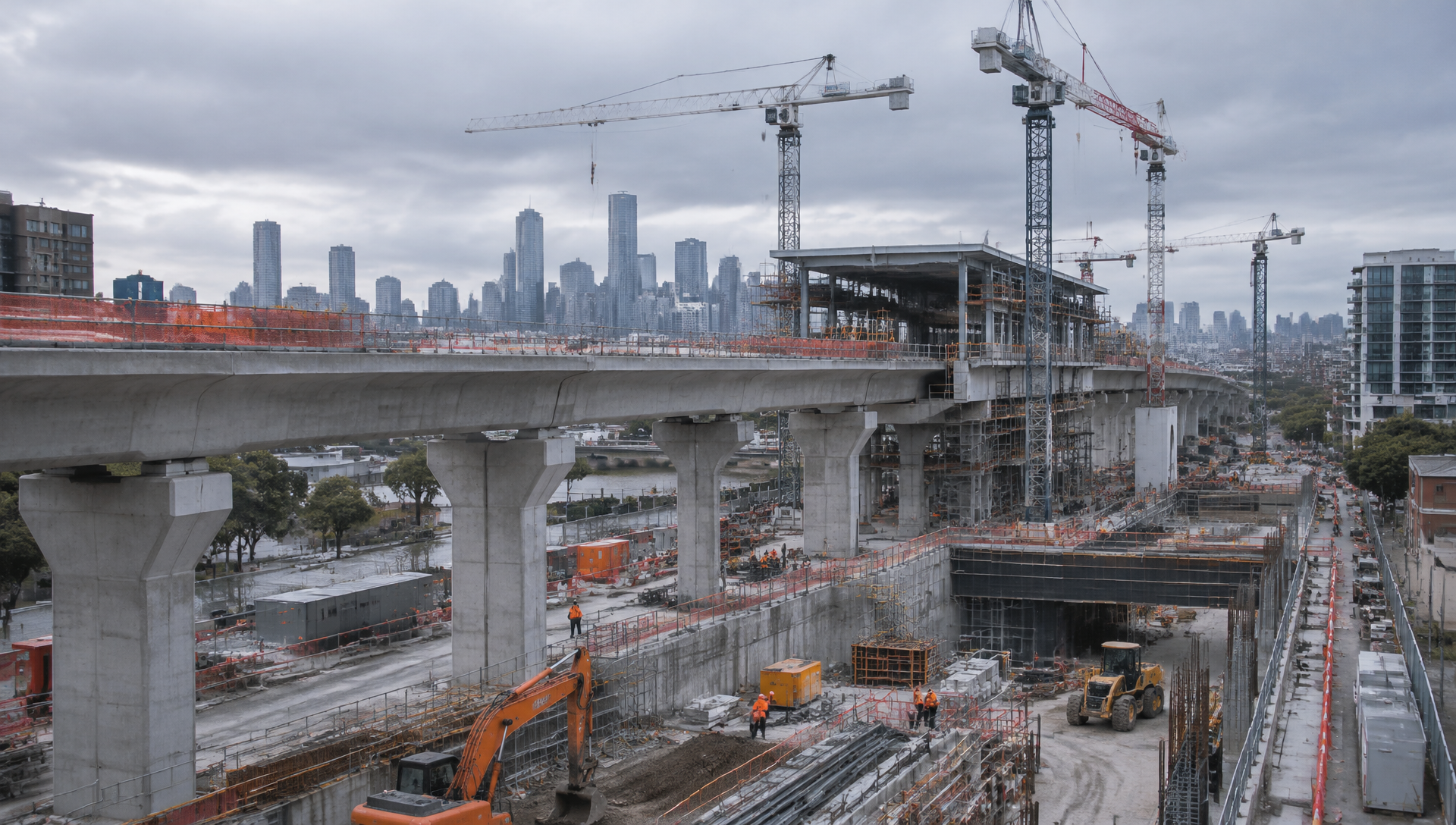
For years, Victorians were told that concerns about corruption, organised crime and intimidation across the state's Big Build projects were being addressed. There were assurances about oversight, governance, compliance and the actions of law enforcement agencies.
Yet the allegations kept coming.
Contractors described intimidation. Businesses reported being pressured into arrangements they did not want. Allegations emerged of payments to underworld-linked figures simply to secure access to projects on which companies had already won work.
The public was left asking a fairly obvious question: how could this happen across some of the largest taxpayer-funded infrastructure projects in Victoria's history?
We now have a royal commission. That is an important development, and one that I strongly advocated for alongside others who recognised that existing mechanisms had failed to establish the full extent of the problem.
But establishing a royal commission is not the achievement by which this matter should ultimately be judged.
The real test is whether it follows the money, identifies the systems that enabled misconduct, establishes accountability and produces consequences.
Follow the money, not just the personalities
Organised crime is an enterprise. It exists to make money.
Violence, intimidation, corruption and influence are tools used to protect and expand that enterprise. They are rarely the ultimate objective.
Having worked as a detective investigating organised crime during Melbourne's gangland era, and later in covert corruption investigations and anti-corruption leadership, I have seen how criminal enterprises exploit opportunities created by weak institutions, compromised relationships and inadequate oversight.
The Big Build allegations have many of these characteristics.
The reported payments involving underworld-linked figures should not simply be examined as isolated transactions between individual businesses and intermediaries.
The commission needs to understand the broader financial ecosystem.
Where did the money originate? Who authorised the payments? What services were supposedly provided? Were the payments ultimately absorbed into project costs? Were they passed through subcontracting arrangements? Who benefited directly and indirectly?
And critically, did the structure of government contracts and project delivery create opportunities for these payments to occur without meaningful scrutiny?
These questions go to the heart of the matter.
A payment can be documented, invoiced and processed through an apparently legitimate commercial arrangement without necessarily being legitimate in substance.
A contract does not establish integrity. An invoice does not establish a genuine service. And compliance with a payment approval process does not establish that public money has been properly spent.
That distinction matters enormously.
The cost to taxpayers must be established
There has been considerable public discussion about how much corruption, intimidation, inefficiency and improper conduct may have added to Victoria's infrastructure costs.
Some estimates have reached into the billions. But estimates, however alarming, are not evidence of the precise loss.
The commission should establish what can actually be demonstrated.
That requires forensic financial analysis, examination of procurement decisions, contract variations, subcontracting arrangements, labour costs, consultancy payments and the circumstances in which companies were allegedly pressured to incur additional expenditure.
It also requires distinguishing legitimate construction costs from expenditure attributable to improper conduct.
Victorians deserve an evidence-based assessment, not another political argument over competing estimates.
Where improper payments or unjustified costs are identified, there should be serious consideration of recovery.
Public money must not become an accepted cost of doing business in an environment where intimidation and criminal influence are tolerated.
What did government know, and when?
The question of government accountability cannot be avoided.
Documents presented during the commission's September opening hearing included ministerial briefings from June 2023 addressing concerns about industrial relations issues and alleged criminal elements on major projects.
Those documents make the examination of institutional knowledge and government response essential.
But the commission should not stop at establishing whether a minister received a briefing.
It must examine what happened afterwards.
What action was recommended? Who was responsible for implementing it? What information was provided to senior officials? Were risks escalated? Were effective controls introduced? Did anyone question whether existing arrangements were sufficient?
And if warnings continued, why did the system fail to respond more effectively?
There is a fundamental difference between receiving information and accepting responsibility for acting upon it.
Equally, receipt of a briefing is not itself proof of wrongdoing. The purpose of an independent inquiry is to establish the evidence fairly, including the context in which decisions were made.
However, public accountability requires more than demonstrating that a matter was referred to another agency or discussed at another meeting.
Government cannot contract out responsibility for the integrity of publicly funded projects.
The witnesses must be protected
One of the most troubling aspects of the Big Build allegations is the reported climate of fear.
It is easy for politicians and senior executives to ask why individuals did not report suspected wrongdoing earlier.
That question becomes considerably less persuasive when those individuals believe their livelihoods, businesses or personal safety could be placed at risk.
In environments where organised crime and intimidation may be present, silence should never automatically be interpreted as consent.
Witnesses need confidence that their information will be assessed independently, that their safety will be taken seriously and that making a disclosure will not simply end their commercial future.
The commission has the opportunity to obtain evidence that may not previously have been available to investigators or regulators.
That opportunity must be supported by appropriate confidentiality arrangements, protection against retaliation and careful coordination with criminal investigative agencies.
We should also recognise that royal commissions are not criminal courts. Allegations must be tested, individuals must receive procedural fairness, and evidence of criminal conduct must be handled in a manner that protects the integrity of any subsequent prosecution.
A successful inquiry must be capable of producing both public accountability and legally sustainable consequences.
A system that rewarded silence
There is another issue that deserves close examination.
Large infrastructure projects create powerful commercial incentives.
Contractors want to retain work. Subcontractors need continued access. Project managers want deadlines met. Government wants projects delivered. Political leaders want announcements and visible progress.
These incentives are not inherently improper.
But when the pressure to keep projects moving becomes more important than confronting serious integrity concerns, a dangerous environment can develop.
Problems are managed rather than resolved. Concerns are referred elsewhere. Responsibility becomes fragmented across contractors, agencies, regulators and government departments.
Each participant can point to another part of the system.
And the system continues.
This is why the commission must examine organisational culture and commercial incentives, not simply the conduct of individuals accused of wrongdoing.
The essential question is whether the operating environment created conditions in which improper conduct could be accommodated as a commercial inconvenience rather than confronted as an integrity threat.
If that occurred, identifying a handful of offenders will not fix the problem.
Independent institutions need more than powers on paper
The commission should also examine whether law enforcement and integrity agencies had the legislative authority, resources, intelligence-sharing arrangements and operational capability required to respond effectively.
There is little value in condemning police or regulators for not taking action if the conduct they were encountering fell outside their powers or if the regulatory framework was inadequate.
That does not remove accountability from those institutions. It requires the commission to identify precisely where responsibilities, powers and responses were deficient.
My experience in anti-corruption work, including in Papua New Guinea, reinforced a fundamental lesson.
Political will is not demonstrated by announcing new institutions, legislation or inquiries.
It is demonstrated by supporting independent institutions when their work becomes uncomfortable.
That includes investigations that may expose influential businesses, powerful organisations, senior public officials or political decision-makers.
The integrity of an institution is tested most severely when it is expected to investigate those who have influence over the system in which it operates.
This must lead to consequences
The Victorian Government has moved to establish a special prosecutor framework intended to support action on evidence uncovered through the commission.
That is a constructive development, provided the framework is effective and properly independent.
But the accountability process must extend beyond potential criminal prosecutions.
There should also be consideration of civil recovery, regulatory sanctions, procurement exclusions, licensing action, disciplinary proceedings and structural reform where the evidence justifies them.
There will be difficult legal and commercial questions. Contracts cannot simply be disregarded without lawful grounds, and allegations alone do not establish liability.
Nevertheless, complexity must not become the excuse for continued inaction.
Where arrangements are found to have been improperly obtained or used to facilitate corruption, intimidation or criminal benefit, the relevant authorities should have the powers and determination to disrupt them.
The flow of money is often central to the survival of criminal enterprises.
If financial benefits continue uninterrupted, removing individual participants may achieve very little.
Victorians deserve more than another report
The royal commission is an opportunity to establish the truth about what happened across major public infrastructure projects and to restore confidence in the integrity of public expenditure.
It is also an opportunity to demonstrate what genuine institutional accountability looks like.
The commission should be free to follow the evidence wherever it leads, including into government departments, contracting organisations, unions, commercial intermediaries and the decisions of those responsible for oversight.
Good work should be recognised where it occurred. Those who acted with integrity, resisted pressure or attempted to expose wrongdoing deserve acknowledgment and protection.
But where serious failures are established, accountability must be equally clear.
We have seen too many inquiries expose misconduct, identify deficiencies and recommend reform, only for the underlying incentives and cultures to remain largely unchanged.
This royal commission must not become another exercise in documenting what went wrong while leaving the machinery that enabled it intact.
Follow the money.
Establish who knew what, and when.
Protect those prepared to speak.
Identify the institutional failures.
Recover public money where the law and evidence permit.
And ensure those responsible face meaningful consequences.
Victorians have already paid enough.
They deserve the truth — and a system that makes sure they do not have to pay for these failures again.
Daniel Baulch is a former senior police and anti-corruption executive, a former Deputy Commissioner (Operations) of Papua New Guinea's Independent Commission Against Corruption, and founder of Integrity Solve. He appeared in the 60 Minutes Australia investigation into organised crime and corruption concerns surrounding Victoria's Big Build.
Daniel provides media commentary and public speaking on corruption, organised crime, financial crime, institutional integrity and government accountability.
Media and speaking enquiries: https://danielbaulch.com